
Why Most Farm Automation Doesn't Increase Crop Productivity

Farm automation is becoming increasingly important as agriculture faces labour shortages, water scarcity, climate variability and the growing need to produce more from limited resources. But there is an important question we need to ask:
Does farm automation actually make the crop more productive?
Automation can certainly make farming easier. It can reduce manual intervention, save time, improve control and allow farmers to operate irrigation and other equipment remotely. But a farm does not generate revenue simply because it is automated. The crop does. And that changes the way we should think about agricultural automation.
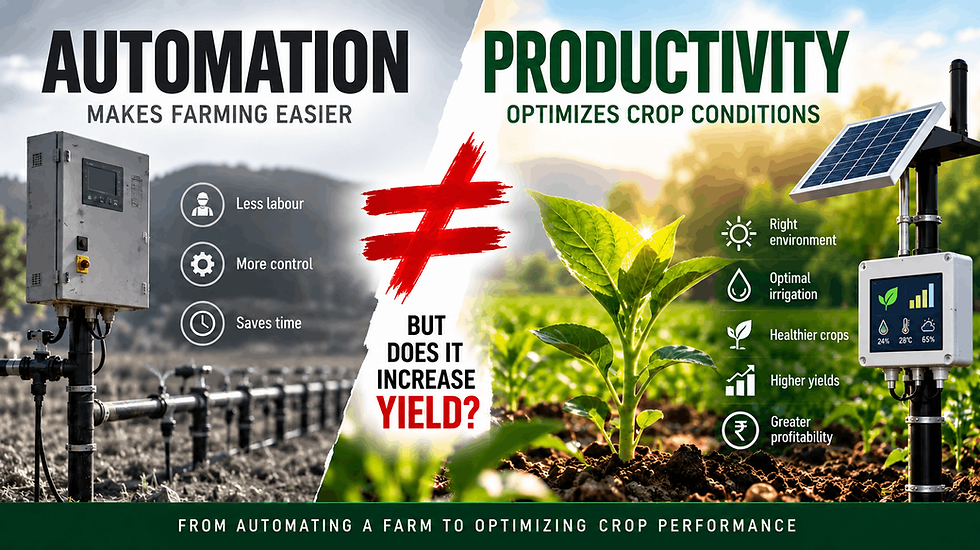
From Automating the Farm to Optimizing Crop Performance
Much of the agricultural automation available today is designed around automating a task.
Turn the pump on -> Open a valve -> Close a valve -> Turn the pump off
Start irrigation at 6 AM -> Stop irrigation after 30 minutes.
These systems can provide significant benefits. They can reduce labour requirements and give farmers greater control over their operations. But crops don't grow according to a clock.
A plant responds continuously to its environment. Its growth and productivity are influenced by factors such as light, carbon dioxide, water availability, nutrients, temperature, humidity, vapour pressure deficit (VPD), root-zone conditions and soil moisture.
This leads to a fundamentally different question:
Instead of asking how we can automate the farm, should we be asking how automation can create better conditions for the crop?
This is the thinking behind Scientific Farm Automation.
What Is Scientific Farm Automation?
Scientific Farm Automation is an approach to agricultural automation that combines crop science, real-time data, artificial intelligence and automated control. The objective isn't simply to automate what a farmer currently does manually. The objective is to use technology to continuously understand changing crop conditions and make better operational decisions.
The difference can be summarized simply:
Conventional automation:How can we automate the farm?
Scientific Farm Automation:How can we use automation to optimize conditions for the crop?
This distinction is particularly important when we consider one of the most fundamental processes in plant growth: photosynthesis.
Why Photosynthesis Matters to Farm Productivity
Photosynthesis is the process through which plants convert light energy into chemical energy, using carbon dioxide and water to produce carbohydrates.
In simple terms, it is one of the fundamental engines behind plant growth.
That means agricultural productivity isn't just about how much water we apply or how frequently we irrigate.
It is about whether the crop has the conditions it needs to perform effectively.
A simplified view looks something like this:
Light + CO₂ + Water + Nutrients
supported by:
Temperature + Humidity/VPD + Root-zone moisture + Soil conditions
↓
Photosynthesis
↓
Biomass and plant growth
↓
Yield
↓
Farm revenue

This is why simply automating irrigation isn't necessarily the same thing as optimizing crop productivity. The automation needs to understand why and when irrigation is required, rather than merely following a predetermined schedule.
Why Fixed Irrigation Schedules Have Limitations
Consider a conventional irrigation schedule.
A farmer may decide to irrigate a crop for 30 minutes every morning.
But what happens if:
It rains during the night?
The temperature suddenly drops?
Solar radiation is unusually high?
The crop is at a different growth stage?
Soil moisture is already adequate?
Evapotranspiration increases significantly?
The root zone begins drying faster than expected?
The crop doesn't know that the irrigation timer was programmed for 6 AM. Its water requirement is determined by the interaction between the plant, soil and environment. This is where real-time data becomes valuable.
From Data to AI to Automated Action
Any can generate enormous amounts of data.
Soil moisture.
Temperature.
Humidity.
Weather conditions.
Irrigation history.
Crop conditions.
Environmental trends.
But collecting data isn't enough. The real value comes from turning data into decisions. This is where artificial intelligence can play an important role.
Instead of simply asking:
“What happened?”
an intelligent agricultural system can begin asking:
“What is likely to happen next?”
and:
“What should we do about it?”
How GroTron's AI-Based Irrigation Approach Works
GroTron® is designed around this principle. The system combines real-time field information and environmental data with AI-based decision-making and automated control. One of the concepts demonstrated in GroTron's intelligent irrigation approach involves two stages of AI-based decision-making.
AI Model 1 — Predicting Soil Moisture Risk
The first model looks at changing field conditions and predicts the risk of the soil moving away from its desired moisture condition.
Instead of waiting until the soil becomes excessively dry, the system can anticipate the changing moisture balance.
AI Model 2 — Planning Irrigation
The second model uses this information to determine an appropriate irrigation strategy.
The objective is not simply:
“Irrigate because it is 6 AM.”
It is:
“Given the current and predicted crop conditions, when should irrigation happen and how should it be executed?”
The system can then automate the irrigation operation.
This creates a continuous cycle:
Sense → Analyse → Predict → Decide → Automate → Learn
That is a very different concept from simply putting a timer on an irrigation pump.

Automation Should Serve the Crop
This distinction is important because agricultural automation is sometimes evaluated primarily on operational benefits.
How many workers does it replace?
How much time does it save?
How much water does it save?
How much can the farmer control remotely?
These are all legitimate questions.
But there is another question that should be at the centre of the discussion:
What did the automation do for the crop?
If automation saves labour but doesn't improve the crop environment, we may have automated the process without fundamentally improving production. The ultimate objective should be to create an environment in which the crop can perform closer to its potential.
That means thinking about automation in terms of:
Crop conditions → Photosynthesis → Growth → Yield → Revenue
rather than simply:
Automation → Labour savings
Beyond Smart Farming: Scientific Farm Automation
The terms smart farming, precision agriculture, digital agriculture and farm automation are increasingly common.
But technology alone doesn't automatically make farming intelligent. A connected pump is not necessarily an intelligent irrigation system. A sensor collecting soil moisture data is not necessarily a precision agriculture solution. An automated valve is not necessarily improving crop productivity.
The intelligence comes from understanding what the data means, predicting what is likely to happen, and translating those insights into appropriate action. This is where we believe the next evolution of agricultural technology lies.
Science + Data + AI + Automation
Together, these technologies can move agriculture from simply automating tasks toward continuously optimizing crop conditions.
GroTron® — Scientific Farm Automation
GroTron® is Farmagain's technology platform for Scientific Farm Automation.
It brings together technologies including IoT, real-time field monitoring, artificial intelligence and automated control to enable data-driven agricultural management. The system is designed to support applications such as intelligent irrigation, fertigation, environmental monitoring and automated farm operations.
The underlying philosophy is simple:
Don't automate a farm. Automate decisions around the crop.
GroTron® technology has been patented and has been recognized among India's Top 100 Innovations of 2023.
Farmagain has also deployed GroTron technology in Indonesia, including work involving Indonesia's Ministry of Agriculture. The technology has been presented in the context of Indonesia's agricultural development and vision for technology-enabled agriculture.

The Future of Agricultural Automation
Agriculture is facing a difficult combination of challenges.
Labour availability is changing.
Water resources are under increasing pressure.
Weather patterns are becoming less predictable.
Input costs are rising.
And farmers need to produce more efficiently.
Automation can help address some of these challenges.
But the next generation of agricultural automation needs to go beyond simply replacing manual operations. It needs to become increasingly crop-aware, data-driven and predictive. The goal shouldn't be to make a farm that merely runs automatically. The goal should be to create a farm where technology continuously works toward providing the crop with better conditions for growth and productivity.
Because ultimately:
The farm doesn't produce revenue. The crop does.
And that is why we believe the future of agriculture is not simply Farm Automation.
It is Scientific Farm Automation.
From automating a farm to optimizing crop performance.
Watch the full video
We explore this idea in greater detail in our latest video:
About Farmagain
Farmagain Agro Pvt Ltd develops technology for precision agriculture and Scientific Farm Automation, combining agricultural science with IoT, AI, data and automation.
For enquiries:
📞 1800 120 4143📧 enquiry@farmagain.co🌐 www.farmagain.co


Comments